
Creating Treatment Exploration
Redesigned the treatment exploration experience at Hims & Hers to help users identify the right fit for their goals, reducing cognitive load through smarter filtering, categorization, and a focused set of recommendations.
00

problem
When users reached their treatment result at Hims & Hers, 60% wanted to explore other options, but the experience gave them no reliable way to evaluate which treatments aligned with their specific goals. Without clear categorization or filtering, users faced a wall of choices that felt generic rather than tailored, leading to drop-off instead of conversion.
When users reached their treatment result at Hims & Hers, 60% wanted to explore other options, but the experience gave them no reliable way to evaluate which treatments aligned with their specific goals. Without clear categorization or filtering, users faced a wall of choices that felt generic rather than tailored, leading to drop-off instead of conversion.
solution
A redesigned Explore Treatments flow that reduced cognitive load through a simple card layout, a tab-based filter organized by form factor, and a modal pattern for viewing individual treatments without losing their place. Legal constraints around recommendation language were solved by repurposing an existing descriptor tag component to communicate treatment fit through categories rather than clinical claims, keeping the experience both honest and helpful.
A redesigned Explore Treatments flow that reduced cognitive load through a simple card layout, a tab-based filter organized by form factor, and a modal pattern for viewing individual treatments without losing their place. Legal constraints around recommendation language were solved by repurposing an existing descriptor tag component to communicate treatment fit through categories rather than clinical claims, keeping the experience both honest and helpful.
Understanding the User Journey
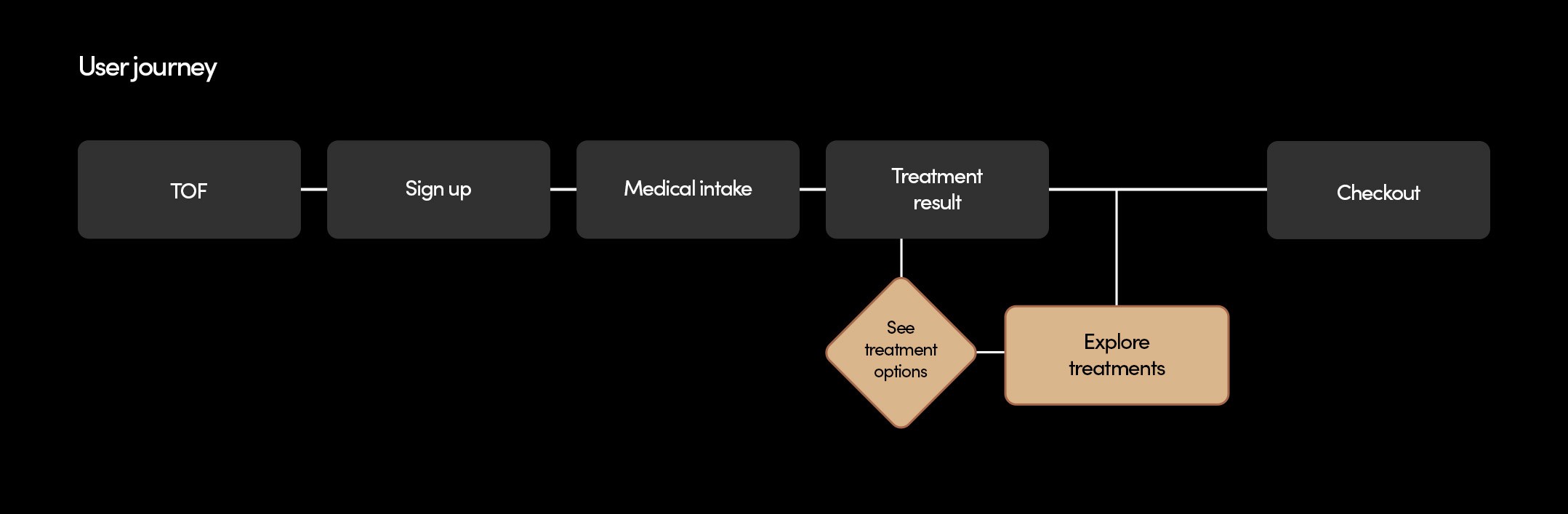
Our Sexual Health user moves through multiple stages of the flow. They start at the top of funnel with a shortened questionnaire designed to hook their interest and encourage them to sign up and learn more about treatment. After signing up, they progress through a medical intake, anywhere from 20 to 50 questions depending on their health information. From there, a treatment recommendation is formulated in the backend based on their specific responses. Once determined, the treatment result is presented to the user. From there, they can learn more about their recommended treatment or explore other options before proceeding to shipping and checkout.
Reducing Friction in Treatment Exploration
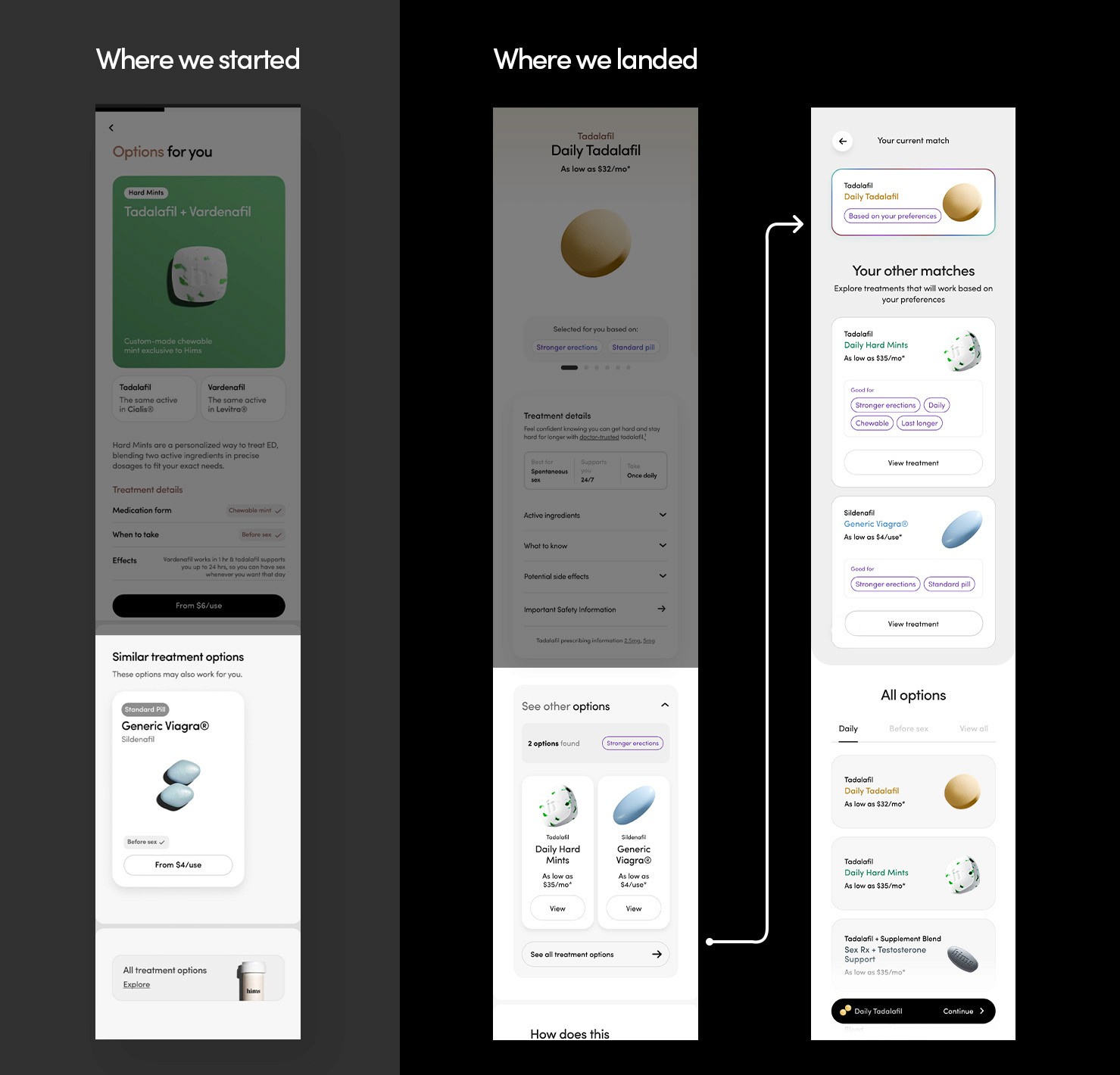
I led the visual design of a redesigned Explore Treatments flow, focusing on hierarchy, labeling, and filtering to help users quickly identify options aligned with their goals. In the old design, the 'similar treatment options' section took up valuable real estate and undermined the user's confidence in their initial recommendation. Our first step was creating an expanding card component that saved space while still giving users the flexibility to explore other treatments. Inside the card, we surfaced two top treatment options based on each user's goals and intake responses.
Navigating Legal Constraints
Legal constraints shaped the solution as well. On the 'see all treatment options' page, we couldn't explicitly claim that any treatment would resolve all of a user's concerns, so we repurposed an existing tag component as a filtering and categorization system that communicated fit without making clinical claims.
Check out the full interaction flow:

Iterating Toward Simplicity
The treatment exploration experience went through multiple rounds of iteration. I explored carousel cards, horizontal scrolling, and bold card layouts before landing on a simpler direction in collaboration with my product manager and marketing team. The result made exploring feel like guidance rather than a wall of options.
Understanding the User Journey
Our Sexual Health user moves through multiple stages of the flow. They start at the top of funnel with a shortened questionnaire designed to hook their interest and encourage them to sign up and learn more about treatment. After signing up, they progress through a medical intake, anywhere from 20 to 50 questions depending on their health information. From there, a treatment recommendation is formulated in the backend based on their specific responses. Once determined, the treatment result is presented to the user. From there, they can learn more about their recommended treatment or explore other options before proceeding to shipping and checkout.
Reducing Friction in Treatment Exploration
I led the visual design of a redesigned Explore Treatments flow, focusing on hierarchy, labeling, and filtering to help users quickly identify options aligned with their goals. In the old design, the 'similar treatment options' section took up valuable real estate and undermined the user's confidence in their initial recommendation. Our first step was creating an expanding card component that saved space while still giving users the flexibility to explore other treatments. Inside the card, we surfaced two top treatment options based on each user's goals and intake responses.
Navigating Legal Constraints
Legal constraints shaped the solution as well. On the 'see all treatment options' page, we couldn't explicitly claim that any treatment would resolve all of a user's concerns, so we repurposed an existing tag component as a filtering and categorization system that communicated fit without making clinical claims.
Check out the full interaction flow:
Iterating Toward Simplicity
The treatment exploration experience went through multiple rounds of iteration. I explored carousel cards, horizontal scrolling, and bold card layouts before landing on a simpler direction in collaboration with my product manager and marketing team. The result made exploring feel like guidance rather than a wall of options.
year
2024
timeframe
2 months
tools
Figma
category
UI/UX
"Gia was a fantastic design partner throughout our treatment exploration work. She quickly understood complex product and business goals, translated them into thoughtful user experiences, and helped us strike the right balance between giving patients meaningful choice without creating unnecessary friction. Her work contributed to a series of successful experiments that improved conversion while helping patients find treatments that best fit their needs."
John B., Hims & Hers, Product Manager


